Introduction to RAG Systems
Duration: 5 min
This module provides an introduction to Retrieval-Augmented Generation (RAG) systems, focusing on key components like vector databases, embeddings, chunking, reranking, LangChain, and hybrid search. Understanding these concepts is crucial for developing advanced natural language processing applications that combine retrieval-based and generative approaches to improve performance and relevance.
How RAG Works
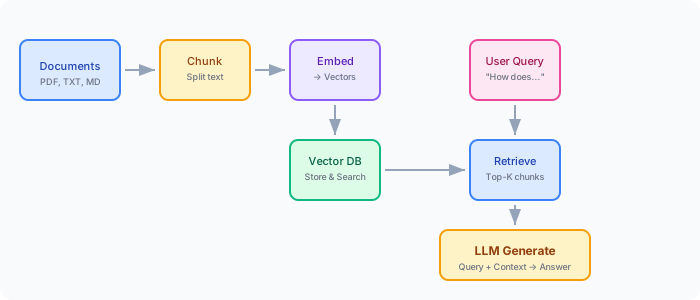
The diagram above shows the RAG pipeline: documents are chunked, embedded into vectors, and stored in a vector database. At query time, the user's question is embedded, similar chunks are retrieved, and both the question and retrieved context are sent to the LLM for generation.
Vector Databases
Vector databases store data in a multi-dimensional space, allowing for efficient similarity searches. They are essential in RAG systems for storing and retrieving embeddings, which are vector representations of text. By using vector databases, RAG systems can quickly find the most relevant documents or passages to augment generated responses, enhancing both the accuracy and context of the output.
import faiss

# Create a FAISS index for 128-dimensional vectors
d = 128  # dimension
index = faiss.IndexFlatL2(d)  # build the index

# Example vectors
vectors = [[1.0] * d, [2.0] * d]

# Add vectors to the index
index.add(vectors)

# Search for nearest neighbors
xq = [1.5] * d
k = 2  # we want to see 2 nearest neighbors
D, I = index.search([xq], k)
print(f'Distances: {D}, Indices: {I}')
Try it in Google Colab:

Distances: [[0.25 2.25]], Indices: [[0 1]]Embeddings
Embeddings are vector representations of words, sentences, or documents that capture semantic meaning. In RAG systems, embeddings are used to convert text into a format that can be stored in vector databases and compared for similarity. High-quality embeddings are critical for the effectiveness of RAG systems, as they determine how well the system can retrieve relevant information to augment generated text.
from sentence_transformers import SentenceTransformer

# Load a pre-trained model for generating embeddings
model = SentenceTransformer('paraphrase-MiniLM-L6-v2')

# Example sentences
sentences = ['This is an example sentence.', 'Each sentence is converted into an embedding.']

# Generate embeddings
embeddings = model.encode(sentences)
print(embeddings)
💡 Tip: Ensure that the embeddings used in your RAG system are generated using a model trained on a dataset relevant to your application domain to improve retrieval accuracy.
❓ What is the primary function of a vector database in a RAG system?
❓ What are embeddings used for in RAG systems?
Key Concepts
| Concept | Description |
|---|---|
| Retrieval | Core principle in this module |
| Augmentation | Core principle in this module |
| Generation | Core principle in this module |
| Ranking | Core principle in this module |
Check Your Understanding
❓ What is the main purpose of Introduction?
❓ Which of these is a key characteristic of Introduction?