Introduction to Prompt Engineering
Duration: 5 min
This module introduces the fundamental concepts of prompt engineering, a crucial skill for effectively interacting with large language models (LLMs). Understanding how to craft prompts can significantly enhance the performance and reliability of LLMs in various applications, making this knowledge essential for developers and researchers in the field.
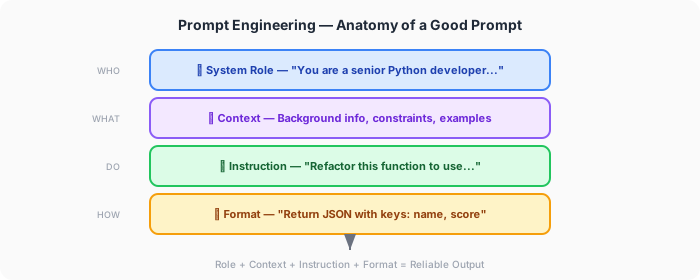
Zero-shot and Few-shot Learning
Zero-shot learning involves providing a model with a task it has never seen before, without any specific examples. Few-shot learning, on the other hand, provides the model with a small number of examples to guide its understanding of the task. Both techniques leverage the model's pre-trained knowledge to generalize to new tasks.
from transformers import pipeline

# Zero-shot classification
classifier = pipeline("zero-shot-classification")

# Example input
hypothesis = "This is a sentence about climate change."
candidate_labels = ['environment', 'politics', 'economy']

# Perform zero-shot classification
result = classifier(hypothesis, candidate_labels)
print(result)
Try it in Google Colab:

{'sequence': 'This is a sentence about climate change.', 'labels': ['environment', 'politics', 'economy'],'scores': [0.982, 0.009, 0.009]}Chain-of-Thought (CoT) and ReAct Prompting
Chain-of-Thought (CoT) prompting encourages the model to provide intermediate reasoning steps before arriving at a final answer. ReAct (Reason + Act) prompting combines reasoning with actionable steps, allowing the model to perform tasks that require both understanding and execution.
from transformers import pipeline

# Text generation with CoT
generator = pipeline("text-generation", model="google/t5-v1_1-base")

# Example input
prompt = "What is the capital of France? Let's think step by step: France is a country in Europe. The capital of France is Paris."

# Generate text
result = generator(prompt, max_length=50)
print(result[0]['generated_text'])
💡 Tip: When using CoT prompting, ensure that the intermediate steps are clear and logically lead to the final answer to improve the model's performance.
❓ What is the primary difference between zero-shot and few-shot learning?
❓ What is the purpose of Chain-of-Thought (CoT) prompting?
Key Concepts
| Concept | Description |
|---|---|
| Tokens | Core principle in this module |
| Context | Core principle in this module |
| Temperature | Core principle in this module |
| Few-shot | Core principle in this module |
Check Your Understanding
❓ What is the main purpose of Introduction?
❓ Which of these is a key characteristic of Introduction?