Introduction to NLP
Duration: 6 min
This module provides an introduction to Natural Language Processing (NLP), a field of artificial intelligence that focuses on the interaction between computers and humans through natural language. Understanding NLP is crucial for developing applications that can understand, interpret, and generate human language, such as chatbots, translation services, and sentiment analysis tools.
Understanding Natural Language Processing (NLP)
Natural Language Processing involves several key tasks, including tokenization, part-of-speech tagging, named entity recognition, and sentiment analysis. Tokenization breaks down text into smaller units called tokens, which can be words or phrases. Part-of-speech tagging assigns grammatical information to each token, while named entity recognition identifies and classifies named entities in text. Sentiment analysis determines the emotional tone behind a body of text.
import nltk
from nltk.tokenize import word_tokenize

# Sample text
text = "Natural Language Processing is fascinating!"

# Tokenize the text
tokens = word_tokenize(text)

# Print the tokens
print(tokens)
Try it in Google Colab:

['Natural', 'Language', 'Processing', 'is', 'fascinating', '!']Introduction to Transformers and BERT
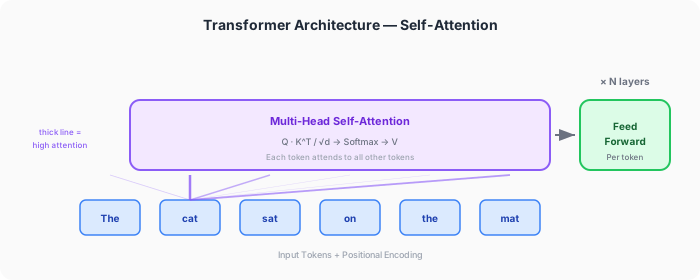
Transformers are a type of deep learning model architecture that has revolutionized NLP. BERT (Bidirectional Encoder Representations from Transformers) is a specific transformer model developed by Google that has achieved state-of-the-art results on a variety of NLP tasks. BERT is designed to understand the context of a word in a sentence by looking at the words before and after it, which allows it to capture more nuanced meanings and relationships between words.
from transformers import BertTokenizer, BertModel
import torch

# Initialize BERT tokenizer and model
tokenizer = BertTokenizer.from_pretrained('bert-base-uncased')
model = BertModel.from_pretrained('bert-base-uncased')

# Sample text
text = "Learning NLP with BERT is exciting!"

# Tokenize and convert to tensors
inputs = tokenizer(text, return_tensors='pt')

# Get model output
outputs = model(**inputs)

# Print the hidden states
print(outputs.last_hidden_state)
💡 Tip: When working with BERT and other transformer models, ensure that your input text is properly tokenized and formatted to avoid errors during model inference.
❓ What is the primary purpose of tokenization in NLP?
❓ What advantage does BERT have over traditional NLP models?