Introduction to MLOps
Duration: 5 min
This module provides an introduction to MLOps, a set of practices that aim to automate and improve the process of building, deploying, and monitoring machine learning models. It covers essential concepts such as CI/CD for ML, Feature Stores, Model Registry, Drift Detection, A/B Testing, Kubeflow, and SageMaker. Understanding these concepts is crucial for effectively managing machine learning workflows in production environments.
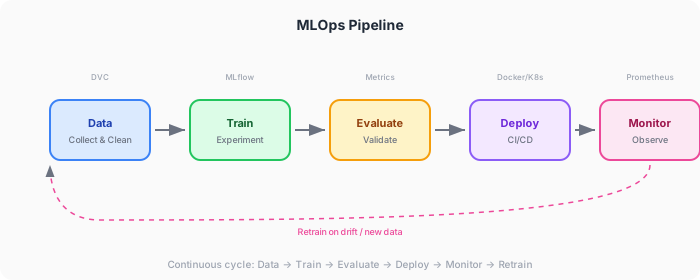
CI/CD for Machine Learning
Continuous Integration and Continuous Deployment (CI/CD) for machine learning involves automating the process of integrating code changes, running tests, and deploying models to production. This practice ensures that models are consistently updated and validated, reducing the risk of errors and improving overall model performance.
import os

# Simulate a CI/CD pipeline step
def run_ci_cd():
    # Check for code changes
    if os.path.exists('model_changes.txt'):
        print('Code changes detected. Running tests...')
        # Run tests
        run_tests()
        print('Tests passed. Deploying model...')
        # Deploy model
        deploy_model()
    else:
        print('No code changes. Skipping CI/CD pipeline.')

# Simulate running tests
def run_tests():
    print('Running tests...')
    # Simulate test results
    test_results = {'accuracy': 0.95}
    if test_results['accuracy'] > 0.9:
        print('Tests passed.')
    else:
        print('Tests failed.')

# Simulate deploying model
def deploy_model():
    print('Deploying model to production...')

# Execute CI/CD pipeline
run_ci_cd()
Try it in Google Colab:

Code changes detected. Running tests...
Running tests...
Tests passed.
Deploying model to production...
Feature Stores
A Feature Store is a centralized repository for storing, versioning, and serving machine learning features. It allows data scientists and engineers to reuse features across different models and experiments, ensuring consistency and reducing the time spent on feature engineering.
import pandas as pd

# Simulate feature data
data = {'user_id': [1, 2, 3], 'age': [25, 30, 35], 'purchases': [10, 15, 20]}
df = pd.DataFrame(data)

# Save features to Feature Store
def save_to_feature_store(df):
    print('Saving features to Feature Store...')
    # Simulate saving to Feature Store
    feature_store = df.to_dict()
    print('Features saved:', feature_store)

# Load features from Feature Store
def load_from_feature_store():
    print('Loading features from Feature Store...')
    # Simulate loading from Feature Store
    loaded_features = {'user_id': [1, 2, 3], 'age': [25, 30, 35], 'purchases': [10, 15, 20]}
    loaded_df = pd.DataFrame(loaded_features)
    print('Features loaded:', loaded_df)
    return loaded_df

# Save and load features
save_to_feature_store(df)
loaded_df = load_from_feature_store()
💡 Tip: Ensure that features in the Feature Store are well-documented and versioned to avoid confusion and errors during model training and deployment.
❓ What is the primary goal of CI/CD for machine learning?
❓ What is the purpose of a Feature Store in MLOps?
Key Concepts
| Concept | Description |
|---|---|
| Pipeline | Core principle in this module |
| Monitoring | Core principle in this module |
| Versioning | Core principle in this module |
| Deployment | Core principle in this module |
Check Your Understanding
❓ What is the main purpose of Introduction?
❓ Which of these is a key characteristic of Introduction?