introduction-to-deep-learning
Duration: 6 min
This module provides an introduction to deep learning, a subset of machine learning, which is revolutionizing the field of artificial intelligence. We will explore the fundamental concepts, architectures, and practical applications of deep learning using PyTorch, a powerful and flexible deep learning framework.
Visual: Neural Network Layers
Input Layer    Hidden Layers    Output Layer
    ●              ●                ●
    ●              ●                ●
    ●              ●                ●
    ●              ●                ●

    x₁            h₁,h₂,h₃          y
    x₂            (neurons)      (prediction)
    x₃
    x₄

Forward Pass: x → h → y
Backward Pass: ∂L/∂w ← gradients
Key Concepts Table
| Concept | Definition | Role |
|---|---|---|
| Neuron | Computational unit | Processes input |
| Weight | Connection strength | Learned parameter |
| Bias | Offset term | Learned parameter |
| Activation | Non-linearity | Introduces complexity |
| Forward Pass | Input → Output | Prediction |
| Loss | Error measure | Optimization target |
| Backprop | Gradient computation | Weight updates |
Understanding Neural Networks
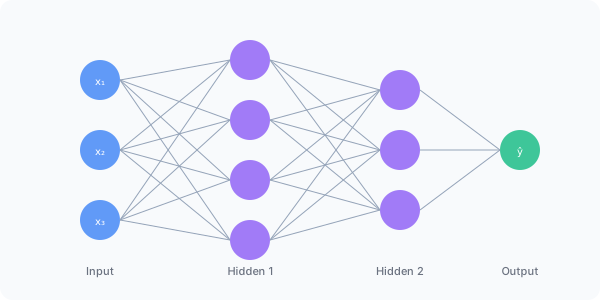
Neural networks are the core of deep learning, mimicking the way the human brain processes information. They consist of layers of interconnected nodes (neurons) that can learn from data. Each neuron takes input, applies a weight, sums it, and passes it through an activation function to produce an output. This process is repeated across multiple layers, allowing the network to learn complex patterns.
import torch
import torch.nn as nn
import torch.optim as optim

# Define a simple neural network
class SimpleNN(nn.Module):
    def __init__(self):
        super(SimpleNN, self).__init__()
        self.fc1 = nn.Linear(10, 5)
        self.fc2 = nn.Linear(5, 1)

    def forward(self, x):
        x = torch.relu(self.fc1(x))
        x = self.fc2(x)
        return x

# Instantiate the model
model = SimpleNN()

# Define loss function and optimizer
criterion = nn.MSELoss()
optimizer = optim.SGD(model.parameters(), lr=0.01)

# Example input
input_data = torch.randn(1, 10)

# Forward pass
output = model(input_data)
print(output)
Try it in Google Colab:

tensor([-0.0123], grad_fn=<ThAddmmBackward>)Training a Neural Network
Training a neural network involves adjusting the weights of the network to minimize the error between the predicted output and the actual output. This is achieved using an optimization algorithm like Stochastic Gradient Descent (SGD). The process includes forward propagation (computing the output), calculating the loss, and backward propagation (updating the weights).
import torch
import torch.nn as nn
import torch.optim as optim

# Define a simple neural network
class SimpleNN(nn.Module):
    def __init__(self):
        super(SimpleNN, self).__init__()
        self.fc1 = nn.Linear(10, 5)
        self.fc2 = nn.Linear(5, 1)

    def forward(self, x):
        x = torch.relu(self.fc1(x))
        x = self.fc2(x)
        return x

# Instantiate the model
model = SimpleNN()

# Define loss function and optimizer
criterion = nn.MSELoss()
optimizer = optim.SGD(model.parameters(), lr=0.01)

# Example input and target
input_data = torch.randn(1, 10)
target = torch.tensor([0.5])

# Forward pass
output = model(input_data)

# Calculate loss
loss = criterion(output, target)
print(f'Loss: {loss.item()}')

# Backward pass and optimization
optimizer.zero_grad()
loss.backward()
optimizer.step()
💡 Tip: Ensure that your input data is properly normalized and preprocessed before training to improve convergence speed and model performance.
❓ What is the primary function of the activation function in a neural network?
❓ Which of the following is a common optimization algorithm used in training neural networks?
Practice Quizzes
Quiz 1: What is the purpose of activation functions?
- Store data
- [✓] Introduce non-linearity
- Compute loss
- Normalize weights
Quiz 2: What does backpropagation compute?
- Predictions
- [✓] Gradients for weight updates
- Loss values
- Activations
Quiz 3: What is a neuron?
- A biological cell
- [✓] A computational unit in NN
- A weight matrix
- An activation function
Quiz 4: Why do we need hidden layers?
- For storage
- [✓] To learn complex patterns
- To reduce computation
- To normalize data