Introduction to AI and Machine Learning
Duration: 4 min
This module provides a foundational understanding of Artificial Intelligence (AI) and Machine Learning (ML), covering essential concepts, algorithms, feature engineering techniques, and model selection strategies. Understanding these basics is crucial for anyone looking to delve into the world of AI and ML, as they form the backbone of intelligent systems and data-driven decision-making processes.
Visual: ML Workflow
┌──────────────┐
│ Raw Data     │
└──────┬───────┘
       │
       ▼
┌──────────────┐
│ Preprocessing│
└──────┬───────┘
       │
       ▼
┌──────────────┐
│ Feature Eng. │
└──────┬───────┘
       │
       ▼
┌──────────────┐
│ Train Model  │
└──────┬───────┘
       │
       ▼
┌──────────────┐
│ Evaluate     │
└──────┬───────┘
       │
       ▼
┌──────────────┐
│ Deploy       │
└──────────────┘
Key Concepts Table
| Stage | Task | Output |
|---|---|---|
| Data Collection | Gather data | Dataset |
| Preprocessing | Clean, normalize | Clean data |
| Feature Engineering | Create features | Feature matrix |
| Model Selection | Choose algorithm | Model type |
| Training | Fit to data | Trained model |
| Evaluation | Test performance | Metrics |
| Deployment | Use in production | Predictions |
Understanding AI and Machine Learning
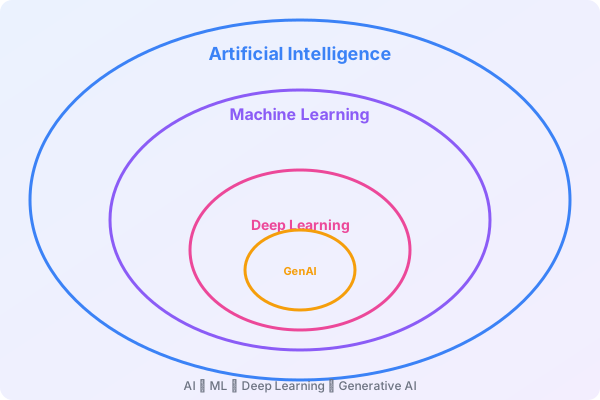
Artificial Intelligence (AI) refers to the simulation of human intelligence in machines that are programmed to think and learn like humans. Machine Learning (ML), a subset of AI, involves training algorithms to make predictions or decisions based on data. ML algorithms learn from and make decisions based on data, identifying patterns and trends to improve their performance over time without being explicitly programmed for each task.
import numpy as np

# Simple linear regression example

# Data points
x = np.array([1, 2, 3, 4, 5])
y = np.array([1, 3, 2, 5, 4])

# Calculate slope and intercept
slope = (np.mean(x * y) - np.mean(x) * np.mean(y)) / (np.mean(x**2) - np.mean(x)**2)
intercept = np.mean(y) - slope * np.mean(x)

# Print the results
print(f'Slope: {slope}')
print(f'Intercept: {intercept}')
Try it in Google Colab:

Slope: 0.8
Intercept: 0.6
Feature Engineering
Feature engineering is the process of using domain knowledge to select and transform raw data into features that improve the performance of machine learning algorithms. Good feature engineering can significantly enhance model accuracy and efficiency. This involves selecting relevant features, handling missing data, encoding categorical variables, and scaling features to ensure they contribute effectively to the model.
import pandas as pd
from sklearn.preprocessing import StandardScaler

# Sample data
data = {'feature1': [1, 2, 3, 4, 5], 'feature2': [10, 20, 30, 40, 50]}
df = pd.DataFrame(data)

# Standardizing features
scaler = StandardScaler()
scaled_features = scaler.fit_transform(df)

# Print the scaled features
print(scaled_features)
💡 Tip: Always evaluate the impact of feature engineering on your model's performance. Sometimes, simple features can yield better results than complex transformations.
❓ What is the primary goal of Machine Learning?
❓ What is the purpose of feature engineering in Machine Learning?
Practice Quizzes
Quiz 1: What is the first step in ML workflow?
- Training
- [✓] Data collection
- Evaluation
- Deployment
Quiz 2: Why is preprocessing important?
- It's optional
- [✓] Improves data quality
- Speeds up training
- Increases accuracy
Quiz 3: What does feature engineering do?
- Trains the model
- [✓] Creates meaningful features
- Evaluates results
- Deploys model